
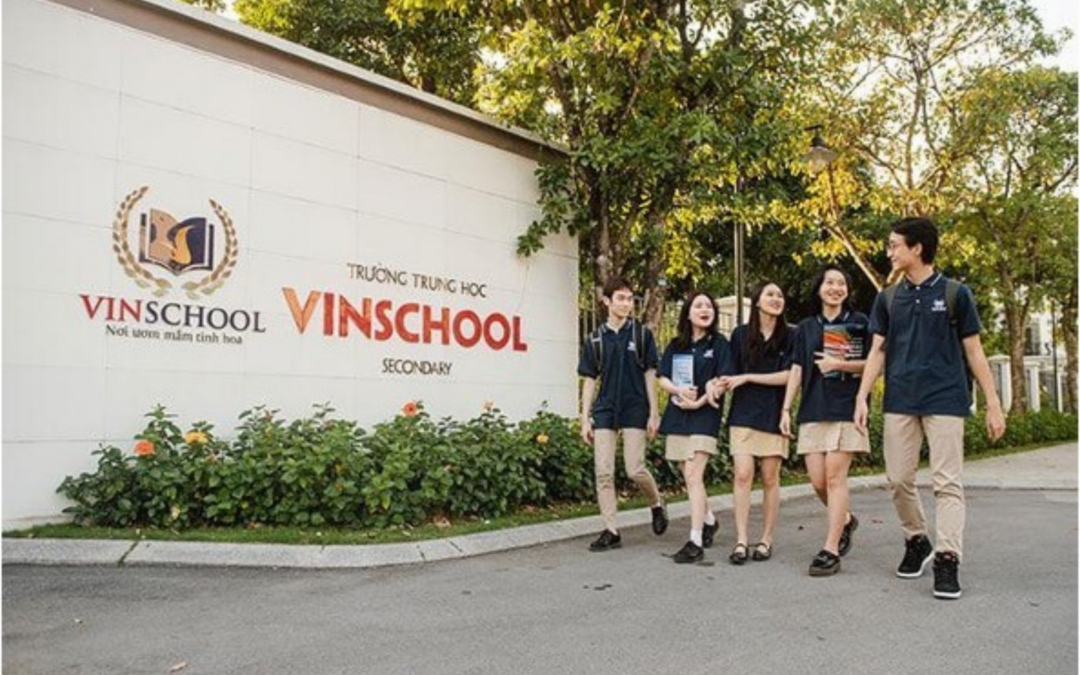
Mental Health First Aid (MHFA) International is proud to welcome Vinschool, Vietnam’s largest private K–12 education system, as our newest international partner – and the organisation introducing Mental Health First Aid® (MHFA) to Vietnam.
With 60 campuses nationwide, Vinschool has built its reputation on developing students who are not only academically strong, but self-directed, resilient and ready to contribute to the world around them – values reflected in its five core principles of Intelligence, Self-direction, Creativity, Integrity and Compassion.
Student wellbeing sits at the centre of that mission, backed by school psychology services, safeguarding systems, and a Student Wellbeing Initiative program recognised with a Bronze Award at the QS Reimagine Education Awards 2025.
MHFA International CEO Angus Clelland said the organisation was delighted to welcome Vinschool as its partner in Vietnam.
“With Vinschool’s extensive education network and school psychology team, this is an opportunity to bring mental health first aid skills into everyday practice, so that more adults have the knowledge and confidence to support students when they need it.
“As our newest International Partner, Vinschool joins a global movement of 10 million people trained in Mental Health First Aid across more than 50 countries globally.”
We spoke to Dr Khuc Nang Toan, Director of the Vinschool School Psychology Program, about why student mental health must become a whole-school responsibility, and what it will take to make MHFA work in Vietnamese classrooms.
Identifying the need for change
Vinschool’s team recognised a gap that counselling and psychological services alone couldn’t close. “Student mental health cannot sit with the school counsellors and psychologists alone,” Dr Toan says. “Teachers and school staff are often the first adults to notice when a young person is struggling.”
Noticing that a student is struggling is not the same as knowing what to do next. “The immediate question is often: ‘What do I actually do?’ Teachers are already carrying significant responsibilities, so we cannot simply ask them to care more about student wellbeing – we need to equip them with practical, structured, and usable skills.”
From specialist responsibility to shared capability
This is the gap MHFA is designed to close – not replacing specialist care, but strengthening the layer around it. Dr Toan says that boundary is important: “We cannot expect teachers to take on the role of counsellors or mental health professionals.” What they need instead is a practical framework for noticing, responding safely, and connecting a student with the right support.
They hope that shift changes the shape of entire school communities across their 60 campuses. “When more adults across a school know how to notice, listen, respond safely, and connect students with appropriate support, mental health becomes a shared responsibility – and the whole school becomes part of the safety net around every student,” Dr Toan says.
Designed for real classrooms
Vinschool’s ambition goes well beyond delivering MHFA as a standalone course. “A teacher needs to be able to apply these skills not in an ideal setting, but on a Monday morning, with a full classroom, limited time, and a student who may be struggling,” Dr Toan says.
The plan is to pair training with realistic school scenarios and ongoing reinforcement, so the learning becomes a capability teachers carry into everyday practice – not knowledge left behind with a certificate.
Cultural context matters just as much. How students express distress, how they approach adults, and what feels appropriate to discuss can all vary across communities. Vinschool’s approach is to contextualise MHFA’s delivery for Vietnamese schools and families, without compromising the integrity of the model itself.
Where to next?
For Dr Toan and the team, success won’t be measured in course completions.
“It is whether participants leave with the confidence to use what they have learned, and whether that capability becomes visible in the everyday moments when a student needs an adult to notice, listen, respond, and help them take the next step.” Growth will follow the same principle: “We want to scale with quality, not simply speed.”
It’s a goal Dr Toan returns to often – one that reframes what success in this partnership really looks like: fewer students slipping through unnoticed, and more adults, in more classrooms, ready for the moments that matter.
Learn more about our International Partners
Mental Health First Aid is now delivered in over 53 countries